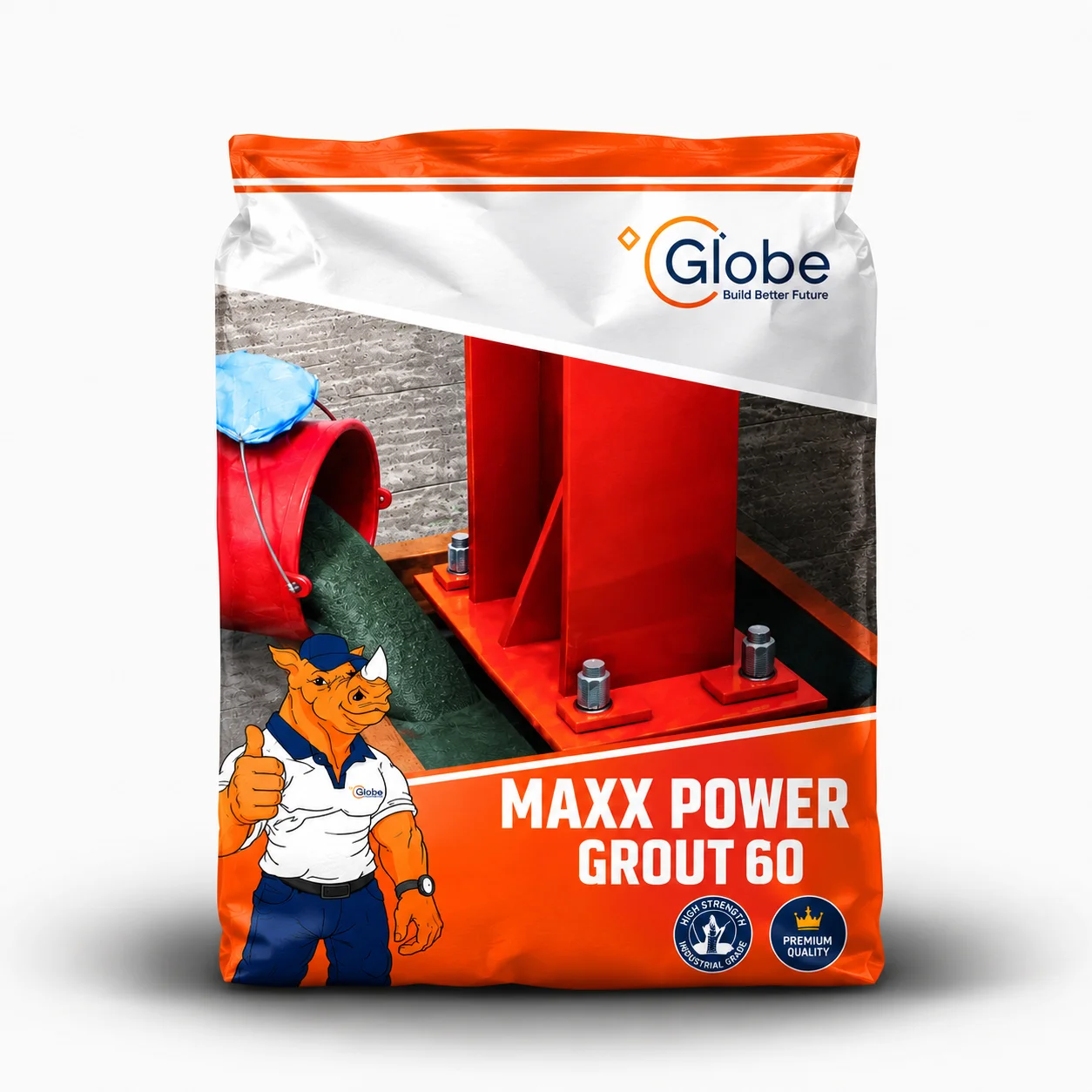
Machine foundations, pump bases, compressor skids, columns and bearing plates depend on a reliable connection between the steel or equipment base and the supporting concrete. The gap beneath a base plate must be filled with a grout that suits the load, geometry and installation conditions. For many precision-grouting applications, contractors specify a non-shrink grout for base plates rather than an ordinary site-mixed mortar.
This guide explains what non-shrink grout does, how to compare products and what to check before grouting at site. Final selection and installation must follow the structural design, approved method statement and current product technical data sheet (TDS).
What is non-shrink grout?
Non-shrink grout is a specially formulated grouting material designed to maintain contact with the surrounding surfaces as it sets and hardens. Cementitious versions are commonly supplied as a pre-blended powder containing cement, graded fillers and performance additives. When mixed with the specified quantity of water, the material is placed into the prepared gap beneath a base plate or into another defined grouting space.
The purpose is to create a continuous bearing layer, fill the designed void and transfer the intended loads to the supporting concrete. The term “non-shrink” should not be treated as a substitute for checking test data, installation limits or engineering design.
Where do contractors use non-shrink grout?
- Machine foundation grouting: base plates for pumps, compressors, turbines, boilers and other equipment.
- Anchor and tie-bolt holes: filling designed bolt pockets and fixing details.
- Bearing plates: creating a bearing layer below structural steel or equipment supports.
- Precast construction: selected column joints, slab joints and connection cavities where the design specifies grout.
- Voids and core filling: filling defined gaps or cavities in concrete elements.
For example, Globe’s Maxx Powergrout 60 is listed for heavy machinery base plates, tie-bolt holes, bearing plates and precast columns. Maxx Powergrout 80 is listed for similar heavy-duty grouting and void-filling applications. The application must still be checked against the design and the relevant TDS.
How to choose the right grout for a base plate
1. Start with the structural requirement
Confirm the equipment or structural load, base-plate dimensions, anchor-bolt arrangement, grout gap and required strength from the approved drawings and engineer’s specification. Do not choose a grout only because its product name contains a high strength number. Compare the declared test values and the project’s specified acceptance criteria.
2. Check flow and placement conditions
A grout must be capable of reaching the full space beneath the plate without leaving pockets. Consider the access point, flow distance, gap geometry, shuttering arrangement and whether the grout will be poured, pumped or placed by another approved method. Confirm the product’s flow characteristics and permitted placement thickness in the TDS.
3. Review volume stability and separation resistance
Look for technical information on expansion or shrinkage control, bleeding, segregation and consistency. These properties matter because a grout that separates or leaves voids can compromise the intended bearing contact. Ask the manufacturer for the relevant test data rather than relying on general marketing terms.
4. Consider strength development and programme
Some projects require a particular design strength, while others also have an early loading or commissioning requirement. Check the strength development schedule, curing requirements and the minimum time before loading. Do not place equipment into service based on a generic number of hours.
5. Confirm compatibility and practical supply details
Check that the grout is compatible with the substrate, base-plate geometry, exposure and installation method. Also confirm pack size, shelf life, storage conditions, water requirement and the quantity needed for the planned pour.
Site checklist before grouting
- Approve the method: review drawings, grout specification, product TDS and the engineer-approved method statement.
- Prepare the concrete: remove laitance, loose material, dust, oil, grease and other contaminants that can affect bond or bearing contact.
- Check the base plate: verify alignment, level, anchor bolts and the specified gap before closing the formwork.
- Make the formwork grout-tight: seal joints and provide a suitable head box or access arrangement where required by the method.
- Measure the mixing water: use the manufacturer’s stated water quantity and mixing sequence. Do not add extra water to make the mix easier to place.
- Place continuously: follow the specified pouring direction and placement method so air can escape and the grout can fill the intended space.
- Protect and cure: follow the product’s curing, temperature and protection instructions. Do not load the equipment until the engineer’s requirements are met.
Common mistakes that lead to grouting problems
- Using ordinary cement mortar where a designed non-shrink grout is specified.
- Adding excess water to increase flow, which can change the product’s performance.
- Leaving dusty, oily or weak concrete beneath the plate.
- Using leaking formwork or an unsuitable pouring arrangement.
- Stopping the pour before the cavity is filled or allowing air pockets to remain.
- Loading the equipment before the specified strength and curing requirements are achieved.
Which Globe grout should you review?
Globe Construction Chemicals lists a range of cement-based structural grouts for different grouting requirements:
- Maxx Powergrout 60 – free-flow, non-shrink cementitious grout with a stated design strength of up to 60 MPa.
- Maxx Powergrout 80 – free-flow, non-shrink cementitious grout with a stated design strength of up to 80 MPa.
- Maxx Powergrout Ultra F 80 – a high-early-strength, non-shrink, pourable and flowable cement-based grout for precision grouting applications.
These descriptions are product-specific; compare the current TDS and project specification before selecting a grade. Visit the structural grout product range or contact Globe Construction Chemicals with the base-plate dimensions, grout gap and project requirement.
Frequently asked questions
Can ordinary cement mortar be used below a machine base plate?
Use the material specified by the structural designer or project specification. Where non-shrink grout is specified, ordinary site-mixed mortar should not be substituted without written approval.
Is higher compressive strength always the best choice?
No. Strength is only one selection factor. Flow, gap dimensions, load type, placement access, strength development and compatibility must also match the application.
How much water should be added to non-shrink grout?
Use only the water quantity stated in the current product TDS. Do not estimate by eye or add water after mixing to restore workability.
When can machinery be started after grouting?
Follow the specified strength requirement, product data and engineer’s approval. The time depends on the product, site conditions and the equipment loading requirement.
Need help selecting structural grout? Share your application details with Globe Construction Chemicals to identify the product data and technical information relevant to your project.