
Spalled concrete, honeycombing, surface cracks and damaged plaster are common repair issues on residential, commercial and industrial projects. The correct repair material depends on the depth and size of the defect, the condition of the surrounding concrete, access to the repair area and whether reinforcement or structural capacity is affected.
Searching for concrete repair mortar can return several product types. Micro concrete, polymer-modified repair mortar, crack filler and bonding agents do different jobs. This guide helps contractors identify the type of material to investigate before preparing a site method statement.
First identify the type of concrete damage
Before ordering a repair chemical, inspect the affected area and identify why it has deteriorated. Common causes include poor compaction, honeycombing, impact damage, water ingress, corrosion of reinforcement, movement, shrinkage and poor previous repairs. If cracks are widening, reinforcement is exposed or the member may be structurally affected, obtain an assessment from the structural engineer. A surface filler is not a structural repair system.
Concrete repair mortar vs micro concrete vs crack filler
| Material type | Typical purpose | What to confirm |
|---|---|---|
| Polymer-modified repair mortar | Hand-applied repair to damaged concrete or plaster surfaces | Permitted thickness per layer, substrate condition, finish and curing |
| Micro concrete | Form-and-pour repair or jacketing where a flowable material is required | Formwork, flow path, reinforcement clearance, placement thickness and strength |
| Fast-setting patch repair | Selected patching, void filling and repair work with time constraints | Working time, setting behaviour, traffic/loading time and application limits |
| Crack filler | Surface cracks in plaster, masonry or concrete where the product is approved | Crack movement, width, depth, moisture and whether the crack is structural |
| Bonding agent | Improving the bond between compatible old and new cementitious layers | Substrate preparation, application window and compatibility with the repair material |
When should contractors use micro concrete?
Micro concrete is considered when the repair geometry requires a flowable material to reach spaces that are difficult to fill by hand. Depending on the designed repair system, applications can include damaged columns, beams, slabs, honeycombed sections, jacketing and larger cavities. It is not simply a stronger version of ordinary plaster. The repair design, reinforcement condition, formwork and access for placing the mix must be checked first.
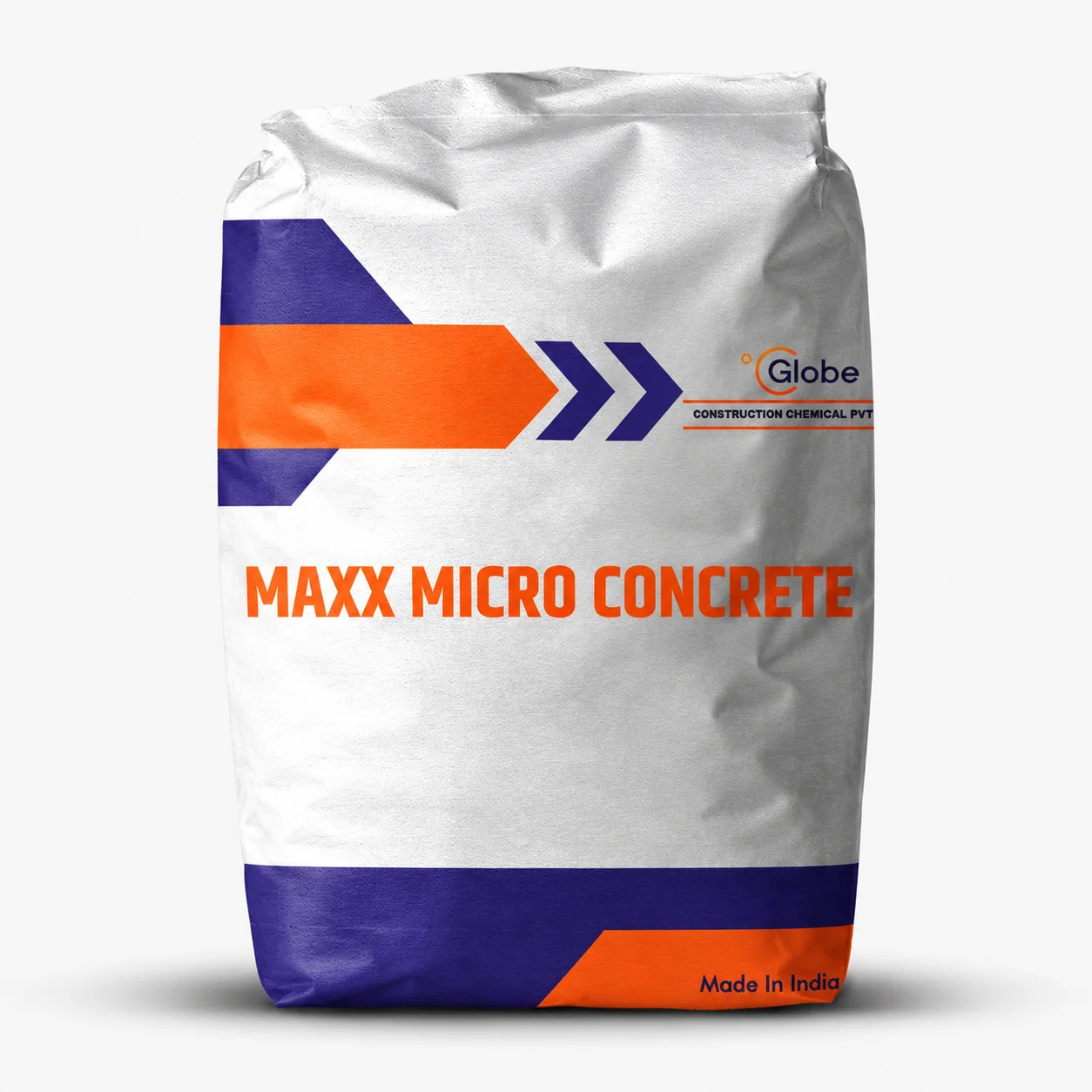
Maxx Micro Concrete is listed by Globe as a polymer-enriched, high-strength, non-shrink material for micro-concreting and jacketing of damaged concrete areas. Its stated applications include damaged structural concrete, columns, beams, honeycombing, slabs and larger gaps. Review the TDS for permitted use and installation limits.
When is polymer-modified repair mortar suitable?
Repair mortar is generally considered for hand-applied patching and restoration where the damage can be prepared and rebuilt in controlled layers. The product must suit the orientation, repair depth, substrate and required finish. A repair to a vertical wall, the underside of a slab and a floor surface may need different product characteristics.
MaxxCon RM is a polymer-modified repair mortar listed for damaged, cracked or spalled concrete and plastered wall surfaces, including honeycombs and surface defects. For selected patching and void-filling work, Globe also lists Rapid Patch H, a pre-packed cementitious repair mortar described as fast-setting and suitable for general patching, runways and industrial flooring. Always compare the product’s application limits with the actual repair dimensions.
What about hairline cracks and surface defects?
Not every visible crack requires the same treatment. A stable, minor surface crack in plaster is different from a moving joint, a water-bearing crack or a crack that may indicate structural distress. Identify the cause and movement first. Do not bridge an active movement joint with a rigid surface paste.
Maxx Crackseal is a ready-to-use crack-filling and sealing compound listed for surface cracks in plaster, concrete and masonry. Its suitability should be checked against the crack type and product instructions. For the interface between smooth concrete and cement plaster, or between old and new plaster, Plast O Bond is listed as a polymeric bonding solution. A bonding agent is not a substitute for removing weak concrete or correcting a structural defect.
Contractor’s repair sequence: a practical checklist
- Diagnose before repairing: record the defect location, extent, likely cause, moisture condition and whether reinforcement is involved. Escalate structural concerns to the engineer.
- Remove unsound material: remove loose, delaminated or weak concrete and plaster until a sound substrate is reached. Follow the approved repair method for edge preparation; avoid feather-edge repairs where the repair specification prohibits them.
- Clean the repair zone: remove dust, laitance, oil, grease and loose particles. If reinforcement is exposed, follow the engineer-approved method for steel cleaning and protection.
- Check the substrate condition: follow the product TDS for dampening, surface saturation and any primer or bonding coat. Do not assume all repair products use the same preparation.
- Choose the correct material: match hand-applied mortar, micro concrete, patch compound or crack filler to the geometry and intended performance.
- Measure and mix accurately: follow the stated water or component ratio, mixing time and usable working life. Do not retemper material that has started setting.
- Place and finish correctly: use the approved layer thickness, compaction or pouring process and formwork where required. Avoid trapped air and incomplete filling.
- Cure and protect: follow the product’s curing requirements and protect the repair from early drying, rain, vibration or premature loading as specified.
Common repair mistakes to avoid
- Applying a crack filler over a crack that is moving or structurally significant.
- Applying new repair mortar over loose concrete, dust, oil or an unsound surface.
- Using micro concrete without designing suitable formwork and a clear filling route.
- Adding extra water to improve workability or extending the mix beyond its stated pot life.
- Ignoring exposed reinforcement, water ingress or the underlying cause of deterioration.
- Skipping curing or allowing early loading before the specified strength is achieved.
Explore Globe concrete repair products
Globe Construction Chemicals lists repair materials for different site conditions, including Maxx Micro Concrete, MaxxCon RM, Rapid Patch H, Maxx Crackseal and Plast O Bond. See the Repair & Restoration category for the wider range.
Frequently asked questions
Is micro concrete the same as concrete repair mortar?
No. Micro concrete is generally selected for flowable, formed repairs or jacketing, while repair mortar is commonly used for controlled hand-applied patching. Confirm the exact application limits in each product TDS.
Can crack filler repair a structural crack in an RCC beam?
Do not assume so. A crack in a structural member requires assessment by a qualified structural engineer before a repair material or method is selected.
Can a bonding agent replace surface preparation?
No. Remove weak material and contaminants first. A bonding agent can only be used as part of a compatible system and according to the manufacturer’s instructions.
Where can I read more about concrete repair methodology?
The National Institute of Disaster Management repair methodology provides a reference on restoration of damaged RCC members. Project-specific repairs still require engineering review and approved product documentation.
Planning a concrete repair? Share photographs, repair dimensions, substrate details and the project specification with Globe Construction Chemicals so the relevant product TDS can be reviewed.