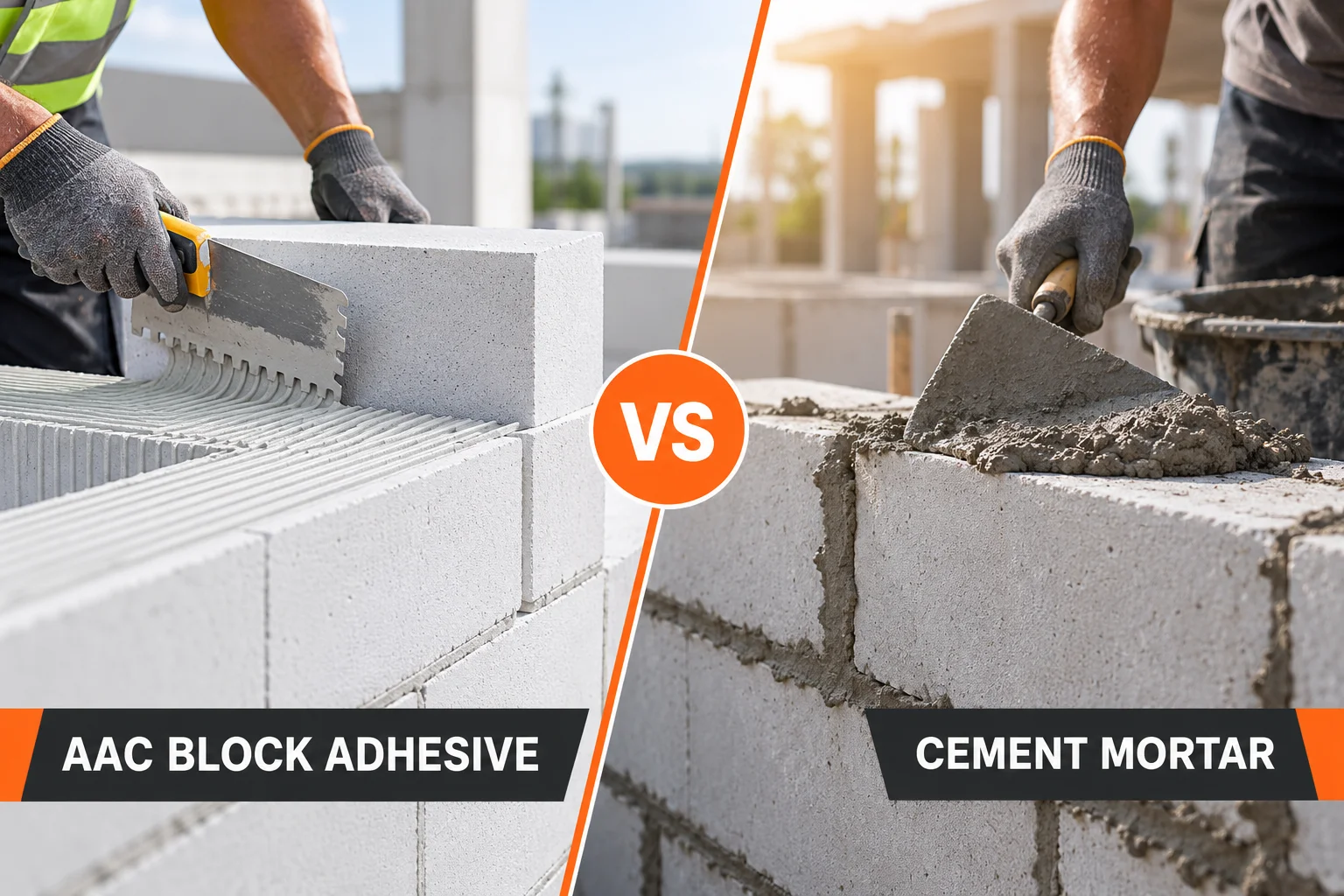
AAC blocks, fly ash bricks and other masonry units need a bonding material that matches the block type, site conditions and construction specification. AAC block adhesive and conventional cement-sand mortar are not interchangeable in every situation. The right choice depends on the block manufacturer’s guidance, the wall design and the adhesive or mortar’s technical data sheet.
What is AAC block adhesive?
AAC block adhesive is a factory-prepared, polymer-modified mortar designed for thin-bed masonry. Products are generally supplied as a dry mix and prepared with water at site. Globe Construction Chemicals’ wall-solution range includes EcoBond AAC Block Adhesive for joining AAC blocks, hollow blocks and fly ash bricks. Always check the current product data sheet for substrate preparation, water dosage, pot life, joint thickness and application instructions before work begins.
What is conventional cement mortar?
Conventional cement mortar is typically prepared by mixing cement, sand and water on site. The mix proportion and sand quality can vary if batching is not controlled. It is used in many types of masonry, but the appropriate mortar must be selected for the specific masonry unit and project specification.
AAC block adhesive vs cement mortar
| Factor | AAC block adhesive | Conventional cement mortar |
|---|---|---|
| Preparation | Factory-prepared dry mix; water is added as instructed | Usually batched on site from separate materials |
| Application | Designed for thin-bed application where specified | Usually applied as a conventional mortar bed |
| Consistency | Packaged formulation supports repeatable mixing when instructions are followed | Can vary with site batching, sand grading and water addition |
| Material planning | Coverage should be calculated from the product data sheet and block dimensions | Consumption depends on mix proportion, joint dimensions and workmanship |
| Best selection basis | Use where the block system and specification permit thin-bed adhesive | Use where conventional mortar is specified and compatible with the masonry |
Key benefits to evaluate
- Bonding: Check the product’s stated bonding performance and suitability for the block type.
- Joint thickness: Thin-bed systems can reduce joint thickness when installed to the specified method.
- Workability: Compare mixing, application time and the skills required on site.
- Quality control: Follow one consistent water dosage and mixing process; do not add unapproved materials.
- Cost per square metre: Compare total material consumption and labour, not just the price of one bag.
How to choose the right material
Confirm the block type and dimensions, consult the masonry or structural specification, review the technical data sheet, and estimate consumption for the planned wall area. Check whether the material requires substrate dampening, what working time is available and when the next construction stage can begin. Do not assume curing or plastering timelines; follow the selected product’s instructions and site specification.
For procurement, ask for the product’s current technical data sheet (TDS), pack size and coverage guidance. Globe Construction Chemicals supplies construction-chemical solutions for projects; view the product catalogue or contact the team to discuss your application.
Frequently asked questions
Can AAC block adhesive be used on every type of brick?
Only use it on masonry units listed in the product’s approved applications. Confirm compatibility in the TDS before use.
Which option is cheaper?
The answer depends on consumption, labour, joint dimensions and site conditions. Compare estimated cost per square metre rather than bag price alone.
Should I use the same mix for every block type?
No. Follow the material manufacturer’s application guidance and the project specification for the particular masonry unit.