Non-shrink grout is a specially formulated grouting material designed to maintain contact with the surfaces it supports while developing the specified strength. It is widely used for machinery foundations, structural steel base plates, precast connections and anchor-bolt pockets. Selecting the right grout and placing it correctly are essential for transferring loads and achieving durable support.
What is non-shrink grout?
Non-shrink grout is typically a cementitious or resin-based material formulated to limit shrinkage during setting and hardening. Cementitious non-shrink grout is commonly supplied as a pre-packed powder that is mixed with a controlled quantity of clean water. Epoxy grout is a different material family and may be selected where project requirements call for particular chemical resistance or performance characteristics.
Where is non-shrink grout used?
- Machine foundations: filling the gap between equipment base plates and concrete foundations to provide continuous bearing support.
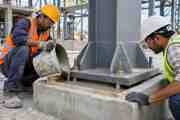
- Steel column base plates: filling the space beneath structural steel base plates after alignment and levelling.
- Anchor bolts: grouting designated bolt pockets and recesses where the approved design specifies it.
- Precast construction: filling selected connections, sleeves and bearing areas in accordance with the structural details.
- Bridge and infrastructure works: grouting bearing plates and other specified support interfaces.
Types of non-shrink grout
1. Cementitious non-shrink grout
Pre-packed cementitious grout is commonly used for general structural and equipment grouting. It is mixed with the specified water quantity and placed within the manufacturer’s stated flow and thickness range. Different grades are designed for different placement gaps and performance requirements.
2. Epoxy grout
Epoxy grouts are resin-based systems used in applications where the design calls for their particular mechanical or chemical-resistance properties. They have different surface preparation, mixing, pot-life and placement requirements from cementitious grout. They should not be treated as interchangeable.
How to apply non-shrink grout under a base plate
- Check the design: confirm the grout type, required strength, placement thickness, bearing area, formwork arrangement and acceptance criteria with the project specification.
- Prepare the concrete: remove laitance, dust, oil, loose particles and other contaminants. Expose sound concrete and follow the grout manufacturer’s instructions for pre-wetting or moisture conditioning.
- Set the formwork: make it watertight and arrange sufficient headbox space to maintain a continuous flow beneath the plate. Plan the placement route to avoid trapped air.
- Mix accurately: use the stated water-to-powder ratio and a suitable mechanical mixer. Do not add extra water to improve flow.
- Place continuously: pour from one side where the method requires it, maintaining a steady head of grout and avoiding interruptions. Do not vibrate unless the product instructions specifically permit it.
- Finish and cure: protect exposed grout and cure it as directed by the manufacturer. Remove formwork only when the specified conditions are met.
- Inspect: check for voids, leakage, cracking or incomplete filling and record the work for quality documentation.
How to select the right grout
Consider the gap thickness, flow distance, base-plate geometry, load and vibration conditions, placement access, ambient temperature, required strength at the relevant age and exposure conditions. Check the product TDS for flow characteristics, compressive strength, expansion characteristics, pot life, working time, recommended thickness, yield and curing procedure. The structural designer’s specification takes priority over a generic selection guide.
Common grouting mistakes
- Using too much water, which can affect strength and performance.
- Placing grout on weak, dusty or contaminated concrete.
- Using unsuitable or leaking formwork.
- Pouring from multiple sides in a way that traps air beneath the plate.
- Exceeding the stated placement thickness or working time.
- Ignoring curing and early-age protection requirements.
Non-shrink grout vs ordinary cement mortar
Ordinary site-mixed cement mortar is not automatically a substitute for engineered non-shrink grout. A purpose-designed grout is formulated for controlled flow, placement and dimensional stability within its declared application range. Use the material specified by the engineer and supported by the relevant technical documentation.
Conclusion
Correct non-shrink grouting combines the right material with accurate mixing, prepared concrete, suitable formwork, continuous placement and proper curing. Contractors should verify the product’s technical data and the project’s structural requirements before starting work.
Explore GlobeChem construction chemical solutions or contact the team for project-specific product guidance.