
Expansion and movement joints help concrete and connected building elements accommodate movement caused by temperature changes, drying shrinkage, structural movement and construction details. If the joint is left open or sealed with an unsuitable material, water, dust and debris can enter and maintenance problems may follow.
A PU sealant for expansion joints is one option used in building and precast construction. The correct choice depends on joint design, expected movement, substrate, exposure and the sealant manufacturer’s application instructions. This guide covers the points contractors should review before using a polyurethane joint sealant.
What is a PU joint sealant?
Polyurethane (PU) sealants are elastomeric sealing materials used to seal selected joints between construction components. One-component products typically cure through reaction with moisture in the surrounding air. A sealant is intended to adhere to the joint faces and accommodate the movement it is designed for; it does not replace the structural design of the joint or repair damaged concrete edges.
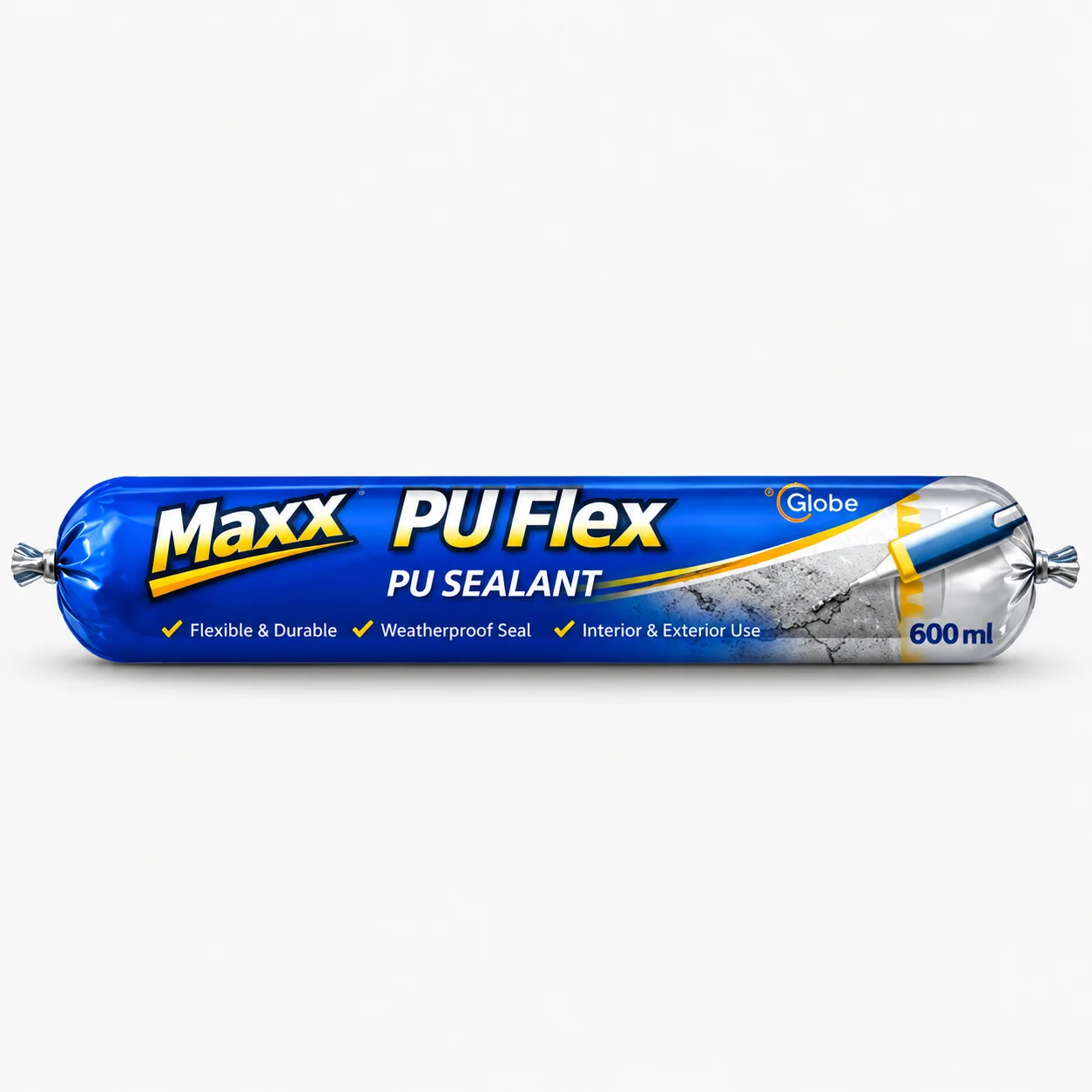
Globe’s Maxx PU Flex is listed as a one-component, medium-modulus polyurethane sealant that cures on exposure to atmospheric humidity. Globe lists applications including heavy and light precast-panel expansion joints, traditional construction expansion joints and selected joinery seams. The current product TDS should be checked for the specific project substrate and exposure.
Where are PU sealants used in construction?
- Expansion joints between precast concrete panels.
- Selected movement joints in traditional concrete construction.
- Joints between compatible building materials such as concrete, brick, ceramic, glass, wood and metal.
- Selected perimeter or joinery seams where the sealant manufacturer confirms compatibility.
- Other designed joints where the expected movement and exposure are within the product’s declared performance.
Not every joint is an expansion joint. Construction joints, control joints, isolation joints and perimeter joints have different purposes. Identify the joint type and confirm the sealant is suitable before applying it.
How to select the right expansion joint sealant
1. Understand expected joint movement
Check the joint design, anticipated movement and dimensions. The sealant must be suitable for the movement demand and joint geometry. Do not select a product only by its chemistry or by the word “flexible” on a label.
2. Confirm substrate compatibility
Check whether the sealant is approved for concrete, masonry, ceramic, glass, painted metal or the other joint faces at the site. Some substrates or coatings may require a primer or special preparation. Make an adhesion test where the specification or manufacturer recommends it.
3. Consider exposure conditions
Record whether the joint is exposed to rain, standing water, sunlight, temperature variation, cleaning chemicals, traffic or other service conditions. Do not assume that all PU sealants are suitable for permanent immersion, all chemical exposures or every exterior condition.
4. Review joint dimensions and backing
Joint width and sealant depth should follow the project design and the product’s technical guidance. A compatible backer rod or bond-breaker may be required to control sealant depth and prevent unwanted adhesion to the back of the joint. Avoid inventing a universal width-to-depth ratio; use the approved joint detail and TDS.
5. Check finishing and future coatings
Confirm whether the sealant is paintable, whether it will remain exposed and whether a coating or finishing material will be applied beside it. Globe lists Maxx PU Flex as paintable, but the paint system and application window should still be checked for compatibility.
PU sealant application: contractor’s site checklist
- Verify the joint: confirm joint type, location, dimensions and expected movement with the approved drawings or method statement.
- Prepare sound joint faces: remove old sealant, loose concrete, dust, laitance, grease and contaminants that could affect adhesion.
- Repair damaged edges: rectify broken or weak joint arrises with an approved repair system before sealing. Do not use the sealant to rebuild a damaged concrete edge.
- Install backing material: place the specified backer rod or bond-breaker at the designed depth. Ensure it is compatible with the sealant.
- Use primer only as specified: follow the sealant TDS for porous or difficult substrates. Do not apply an unapproved primer.
- Apply a continuous bead: gun the material into the joint in a controlled manner, avoiding trapped air and gaps along the joint faces.
- Tool and protect: finish the surface as instructed and protect the joint from water, dust, traffic or disturbance until the product has cured as required.
- Inspect the completed joint: check for discontinuities, pinholes, edge debonding and other visible defects before handover.
Common mistakes when using polyurethane sealant
- Applying sealant to dusty, weak, oily or contaminated joint faces.
- Ignoring joint width, depth or backing requirements.
- Allowing three-sided adhesion where the joint detail calls for a bond breaker.
- Using a sealant that is not compatible with the substrate or service exposure.
- Applying primer or solvent without checking the product instructions.
- Exposing the uncured joint to rain, dust or movement before the manufacturer’s stated protection period has passed.
- Filling a designed movement joint with rigid mortar instead of the specified joint system.
Product option from Globe Construction Chemicals
Maxx PU Flex is Globe’s one-component PU sealant listed for expansion joints in precast panels and traditional construction. Its product page describes adhesion to common construction materials and a 600 ml sausage pack. Review the current TDS for joint design, primer requirements, application limits and curing instructions. You can also browse the Expansion Joint & Sealants category.
Frequently asked questions
Can PU sealant be used for expansion joints in concrete?
It can be suitable where the product is specifically approved for the joint type, substrate, movement and exposure. Confirm the design and product TDS before application.
Is PU sealant the same as cement grout?
No. Cementitious grout fills defined cavities and bearing spaces, while an elastomeric sealant is used to seal designed joints. They are not interchangeable.
Is a backer rod always required?
Not for every detail, but a backer rod or bond-breaker is commonly used to control sealant depth and avoid unwanted adhesion to the joint base. Follow the approved detail and sealant manufacturer’s advice.
Can Maxx PU Flex be used on every building material?
Globe lists adhesion to several typical construction materials. Check the product TDS and perform any required compatibility or adhesion test for the actual substrate and exposure.
Further technical reading
For general PU sealant preparation and joint-design considerations, see Bostik India’s guide to PU sealants. Its guidance is product-specific and should not replace the instructions for the sealant selected for your project.
Need a PU sealant for a project? Share the joint type, dimensions, substrate and exposure conditions with Globe Construction Chemicals before specifying the product.